My weekly writing routine
Washerwomen at Torre del Lago by Eugenio Cecconi
I’m a big fan of David Allen’s Getting Things Done.
It’s one of my top 3 productivity books.
It taught me the power of tying myself to a boring routine (or you can call it SOPs).
Earlier, I had no system to remove day-to-day decision-making.
I remember one day when I woke up and checked my Slack.
There were 3 clients' messages. Two were angry about some editing mistakes. One was ranting about why the content wasn’t ready. I got so anxious that I couldn’t gather the courage to start the work.
There were too many fires to put out.
Instead, my body gave me a headache, and I slept through half the day.
That day, I understood that I had a system problem.
First of all, I needed to stay one week ahead of all my clients. It’s called Buffer Time.
You anticipate problems coming your way from a mile away rather than sneaking up like a ninja in the dark and going straight for your throat.
From that day, I have had a fixed writing schedule.
I wake up knowing exactly what needs to be done. Each day is reserved for one type of task.
Some days, I only write short-form content for all my clients. Some days, I only edit long-form content.
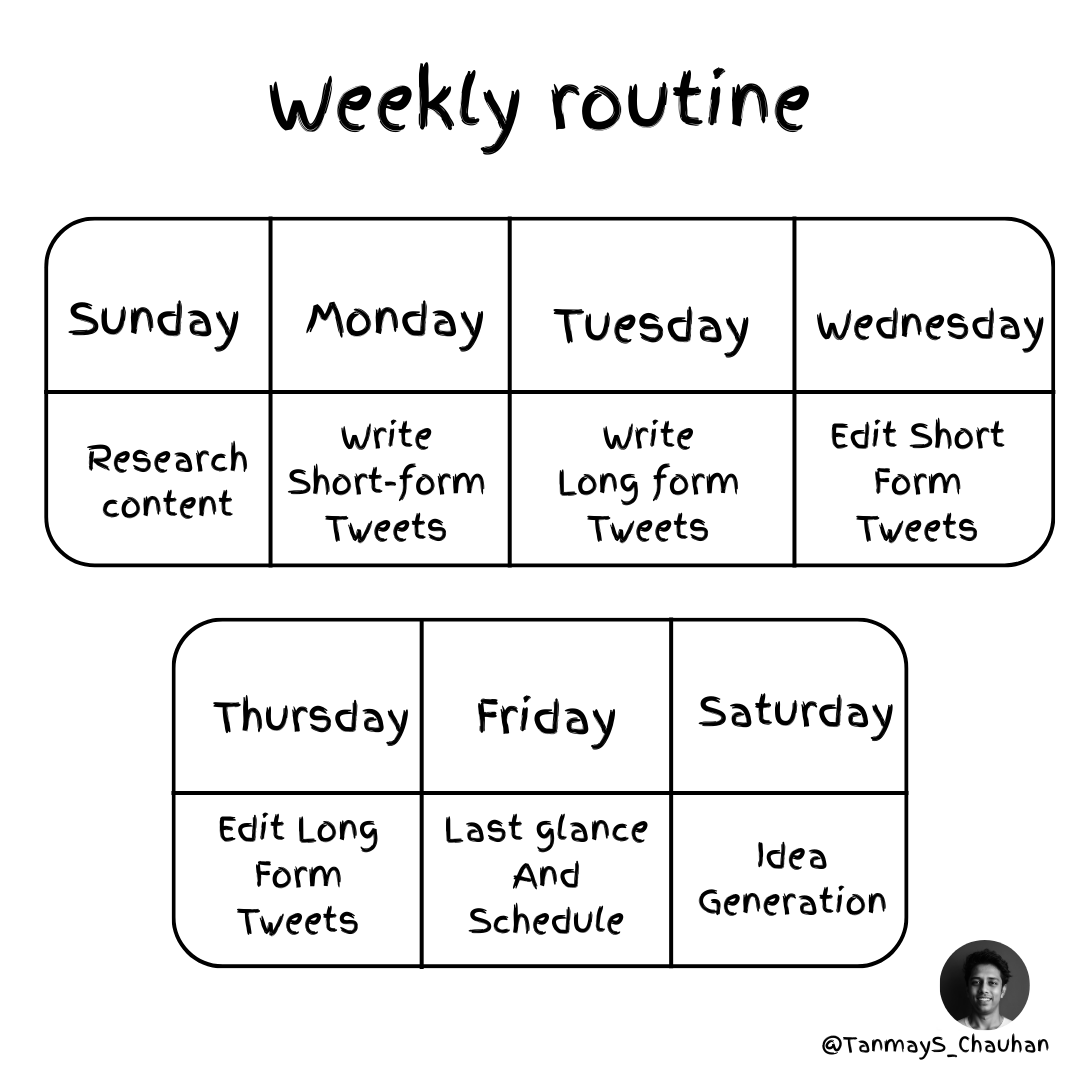
Here’s what my typical week looks like:
Monday
I write the first draft of short-form content for my clients and myself, but no long-form content.
The reason is attention residue from task switching. In the deep workbook by Cal Newport, he discusses why you should batch together similar work. For example, when you’re going out of the house, you do all your outdoor chores in one go rather than going back home and getting out again to do another task.
The same reason applies to why I don’t write long-form content on the same day I write short-form content.
Tuesday
I write the newsletter and long-form content for clients and myself.
The goal is to get all first drafts done. I go through the transcripts from my clients' interviews and use them as a source. Once I have a first draft, the job is half done.
As the saying goes, well begun is half done.
Wednesday
I edit the short-form content, making it snappy and succinct.
If anything doesn’t sit right, I rewrite it. I’ve noticed that on Monday, what feels like a banger often becomes average by Wednesday.
So, it’s good to review them after a while and not edit on the same day.
Thursday
I’m not a great first drafter, so I rely on rewriting.
Mostly, I review whether all the claims I’ve made in my writing are appropriately supported. This can include studies, infographics, videos, or similar viewpoints from credible sources in the niche, or my clients' personal stories.
Friday
I put together everything in a Notion doc and send it to my clients for approval.
Since most of the content comes from our weekly calls, I rarely get asked to make major changes. Mostly, it’s minor adjustments for style and tone.
The content is ready to ship, and I instruct my VA to upload it.
Saturday
Every creator has a different idea-generation process.
Some lean on their creativity, while others rely on data, but I use both. I review my tweets from the past week to see what performed well. Any tweet with over 100 likes and 50+ retweets is a clear winner. It signals that people want more of that content.
If you don’t have a big audience, you do the same process with the 3 biggest creators in your niche.
But always write using data (likes and bookmarks). You don’t want to spend 3 hours on a topic that isn’t validated.
De-risk your content.
Sunday Based on the ideas I’ve generated, I send them for approval by my clients.
This helps me prepare for our weekly interviews. I get the questions ready, and based on that, I do research and find similar content pieces.
The purpose of the research is to understand what other people are saying on that subject.

That's it for the day.
This is part of an email that I sent to my list.
If you wish to read my emails regularly, join my newsletter below.
Thank you for your attention.
That's it for the day.
This is part of an email that I sent to my list.
If you wish to read my emails regularly, join my newsletter below.
Thank you for your attention.