Why content is less like chess and more like poker?

I recently read Annie Duke’s book Thinking in Bets.
She is a professional poker player and a decision-making coach.
Having read this book, I realized how many mistakes I make in my decisions every day.
Most of my decisions as a content agency owner and a ghostwriter are related to content.
And I’m often wrong.
She explains that every decision you make is a bet.
Sometimes it pays off, sometimes it doesn’t, and sometimes you get a lukewarm response.
In a sense, she says Luck + Skill = Outcome.
Hustle culture will tell you that you don’t need luck on your side as long as you work hard.
But as you must have experienced at some point in your life, it doesn’t work that way.
Now, that doesn’t mean it's all luck.
You have something in your control – Skill.
Both of them combined give you better odds to win a bet.
Today, I'll share 3 common mistakes people while making a content decision and 5 ways to avoid them.
Cassius Marcellus Coolidge, A Friend in Need, 1903.
Self-serving bias
Most people, when they’re judging the outcome of a decision, take credit for the win and blame luck for the loss.
Psychologists call it self-serving bias.
I’m sure you’ve heard people say,
“I’m always unlucky."
"Things never go my way. "
"Everything is stacked against me.”
But whenever they win, they take all the credit. You’ll often hear them say,
“See, told you so. I knew it. I’m rarely wrong.”
Research found that 37% of drivers involved in single-car accidents were able to point out the mistakes of others.
Surprisingly, the opposite happens when you’re judging the outcome of someone else.
You give credit to luck when others win and blame their skill whenever they lose.
I can sure as hell tell you that I do this so often I’ve lost count.
This belief doesn’t serve you.
You don’t improve your decision-making skills with such a mindset.
Because you don’t see things as they are, you don’t record the right feedback.
Let’s say one of your threads did well.
You got 50+ subs from it. But since you took all the credit for the win, you keep posting the same content again and again. Boring your audience. Killing your brand reputation. And the results also seem to not go in your favor at all.
Now, you start blaming your luck for the bad outcome.
That’s why you should neither take full credit for your win nor give full blame to luck for your loss.
Life is more complicated than that.
Content is more complicated than that.
Stop-loss
This term is often used by traders.
It is used to limit loss in a trade.
And it's crucial to take them into consideration when you're making a decision.
In content, that would mean time spent on writing and researching.
And sometimes the marketing cost behind it – buying paid slots in newsletters or retweets. However, outcomes are poor indicators of the quality of your decisions.
You can post the best content with high-quality research but still not get much engagement on it.
I'm sure you've seen others putting in less effort but getting more resonance.
"What about those who are not building brands? Are they playing the game?"
The answer is Yes.
Not placing a bet on something is a bet in itself. There is always an opportunity cost in choosing one path over others.
Like life, content is more like poker than chess.
In chess, the odds are completely dependent on your skill.
If you know the right moves, you can NEVER lose.
It’s one of the reasons that in this sport, even the best players can’t beat AI.
Because AI can calculate everything, it never loses.
But content is much more like real life.
You need a little bit of luck and a lot of skills.
When you put a lot of effort into content and don't get the desired results, recognize that outcomes are out of your control.
Say “I don’t know” more often.
Predict in numbers
It’s easy to win a bet against someone who talks in extremes.
“I’m 100% sure.”
“You couldn’t be more wrong.”
“See, I told you, I’m never wrong.”
Such people are blindfolded by their beliefs.
A few times, outcomes went their way, and now they think that’s how it always will be.
Their belief system disregards how much luck plays a role in that, and they’re on a lucky streak.
And when the day comes when the outcome isn’t favorable, they lose big, they go into shock, and feel they were so wrong.
As we all know, losing hurts twice as much as winning feels good – It's called Loss aversion.
Instead of thinking in extremes, being right vs. wrong, Annie suggests you should judge in numbers.
I’m sure you’ve heard some people say,
“I’m 60% sure that Biden will lose elections."
"India has a 90% chance of winning the World Cup."
So whenever you’re putting out content, don’t think in extremes.
Don’t think it will be a banger.
Don’t think you can predict the outcome.
Instead, judge the quality of your content and leave the odds of luck out of it.
A good way of saying it would be, “My content this week is looking solid. I’m 60% sure it will resonate with my audience and bring some warm leads.”
This way, you're implying that you want favorable results, yet keep in mind that results can go the other way.
They are more prepared for setbacks.
They plan more vigorously.
They play long-term games.
How to fix your content decisions:
1. Update your learning loop
Most people refuse to recognize the role of luck in their outcomes.
Luck vs. Skill has always been debated. But no one can say for sure how much of a role it plays in an outcome.
Is it 40% skill or 60% luck? You can never guess.
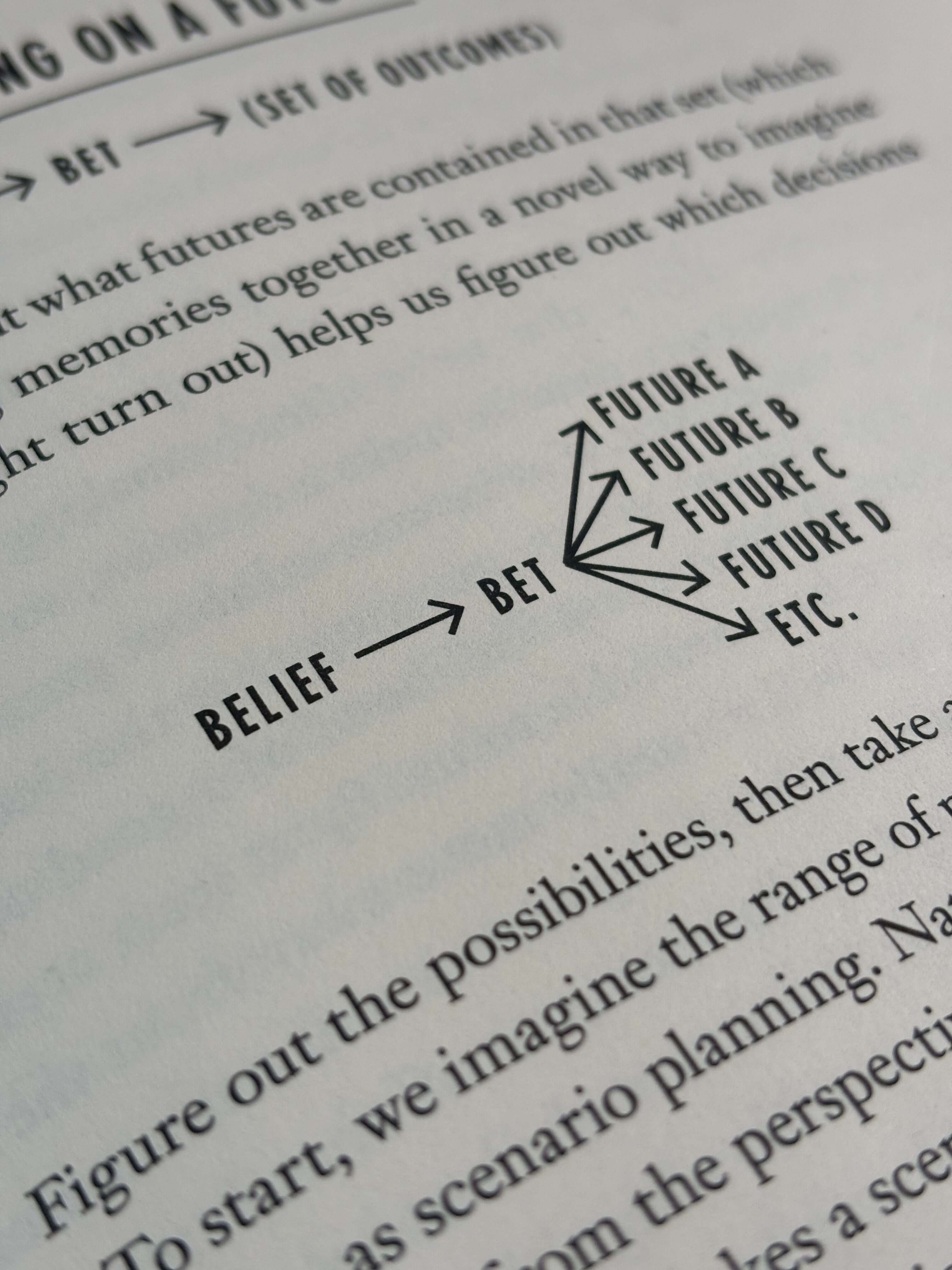
That’s why this should be your learning loop.
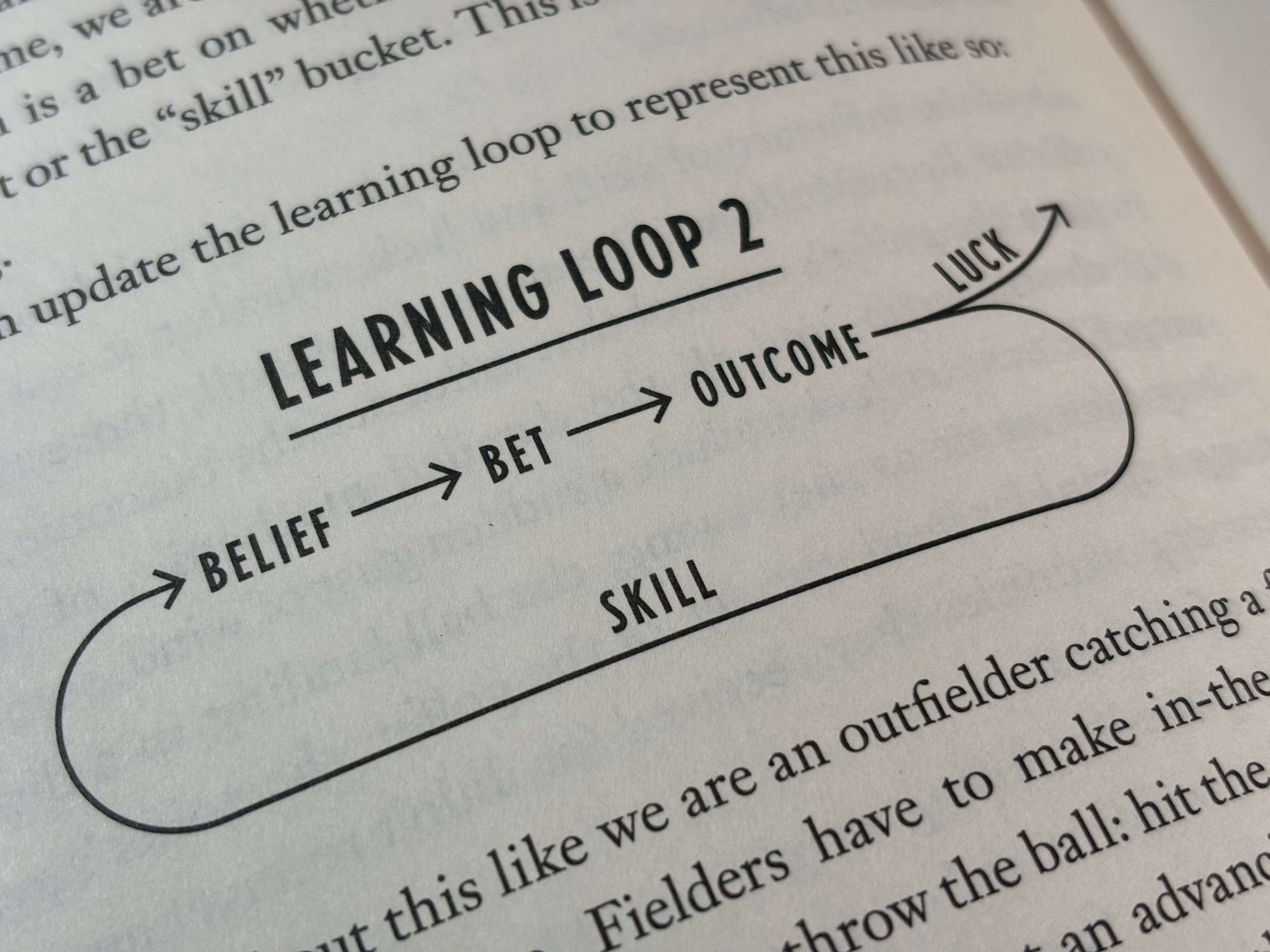
Consider luck in it, but also don’t forget the different kinds of outcomes a decision can bring.
2. Don’t dodge the punches
Whenever you sense people might judge your decision, you hide it from them. You safeguard your beliefs. But it is crucial to get the opinions of others.
They might help you unlock a new outcome that you weren’t counting on at all.
So, if you’re new to writing and online business, join communities, hire mentors, and let others scrutinize your decisions.
Actively looks for feedback.
3. Killing the message because of the messenger
If you’re a normal human being, you dislike some people.
But sometimes, they have good advice, but you ignore it because it doesn’t align with your belief system.
You kill the message because you dislike the messenger.
4. Decision swear jar
We make the worst decisions on impulse. I’m sure this is not news to you.
But sometimes, we fail to identify when we’re impulsive.
So if you catch yourself saying these phrases:
I knew it - Overconfidence
You’re wrong - Delusional information
I’m always unlucky - Moaning and complaining
Stupid, you don’t know - Shooting the message because of the messenger
Remove yourself from the situation.
5. Hindsight bias
Outcomes are like getting out of a forest with a chainsaw.
When you look back, it’s the only route you see. But it doesn’t mean it’s the only route that exists.
You forget that it is the result of the chainsaw that removes all the obstacles in the way.
No one could’ve predicted it. It could only be concluded in the end that such an outcome was possible.
So when you look back on an outcome, don’t think it was the only one that could’ve happened; it was only one of many.
Don’t blame yourself by thinking, “I should’ve known it.”
Nope, you couldn’t have.
We have a tendency to believe that everything is bound to happen and that everyone must have known it.
One final note: I would like to end with this quote from the book:
“Improving decision quality is about increasing our chances of good outcomes, not guaranteeing them.”
That's it for the day.
This is part of an email that I sent to my list.
If you wish to read my emails regularly, join my newsletter below.
Thank you for your attention.
That's it for the day.
This is part of an email that I sent to my list.
If you wish to read my emails regularly, join my newsletter below.
Thank you for your attention.